Unlocking 3D Creativity: The Practical Guide to Activities Book Isometric Paper
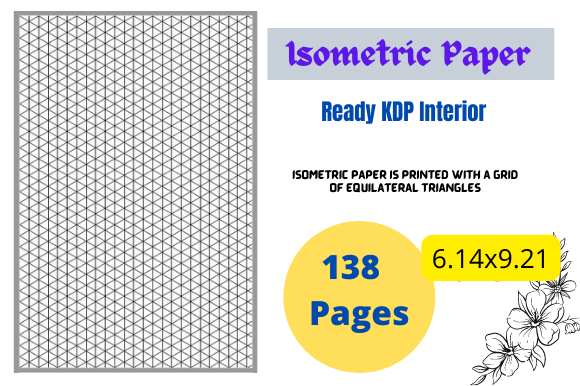
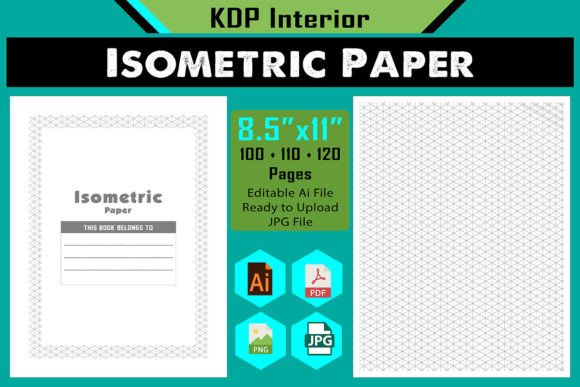
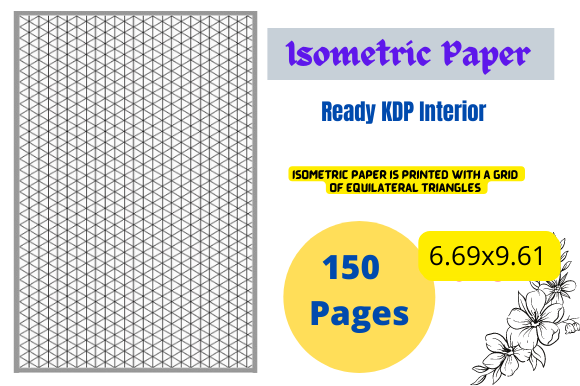
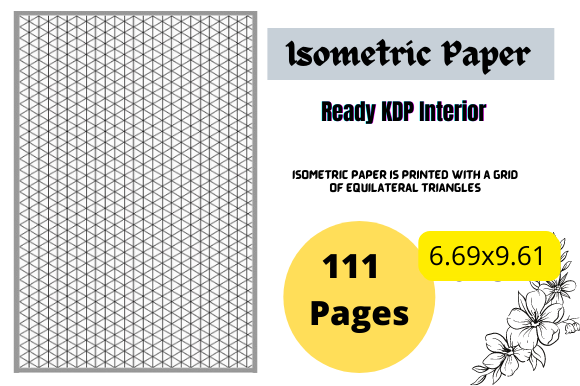
For designers, artists, and makers, the transition from a mental image to a physical representation often hits a wall when using standard lined or blank paper. Perspective is difficult to master freehand, and traditional graph paper restricts creativity to two dimensions. This is where an Activities Book Isometric Paper becomes an essential tool in the creative arsenal. Unlike standard grid paper, this specialized medium is printed with a precise grid of equilateral triangles, each measuring exactly .28 inches. This specific geometry removes the guesswork from three-dimensional drawing, allowing users to sketch volume, depth, and structure with mathematical accuracy and artistic freedom.
The Geometry of Equilateral Triangles
The defining characteristic of high-quality isometric paper is not just the presence of lines, but their specific arrangement. The .28-inch equilateral triangle grid creates a perfect 30-degree angle axis system. When you draw along these pre-printed guides, vertical lines remain vertical, while horizontal lines recede at equal angles. This eliminates the vanishing point distortion found in linear perspective, making it significantly easier to maintain consistent proportions across complex drawings.
This precision is what separates professional-grade isometric notebooks from generic sketchpads. The .28 measurement offers a "Goldilocks" density; it is fine enough to capture intricate details in mechanical parts or architectural features, yet open enough to prevent the page from looking cluttered. For users engaging in technical drafting or artistic exploration, this scale provides a rhythmic guide that keeps hand movements steady and designs aligned without requiring constant ruler measurements.
Bridging Digital Fabrication and Analog Planning
One of the most significant modern applications for an Activities Book Isometric Paper lies in the rapidly expanding world of 3D printing. As schools, colleges, and maker spaces increasingly offer fabrication facilities, the need for rapid prototyping on paper has grown. While CAD software is necessary for the final print, the ideation phase benefits immensely from analog sketching.
Isometric sketches translate directly to 3D modeling software. Because the axes on the paper match the X, Y, and Z coordinates used in programs like Tinkercad, Fusion 360, or Blender, students and engineers can visualize spatial relationships before committing to digital design. This reduces iteration time and helps identify structural flaws early. Whether planning a functional bracket, a custom enclosure, or an artistic sculpture, sketching on a triangular grid ensures that the concept is physically viable before a single layer of filament is extruded.
Educational Applications in STEM and Geometry
Beyond fabrication, this type of paper serves as a tactile learning aid in educational settings. Geometry classes utilize isometric grids to teach spatial reasoning, volume calculation, and cross-sections. Students who struggle to visualize 3D shapes from 2D textbook diagrams often find clarity when they can draw cubes, pyramids, and cylinders on a grid that naturally supports volumetric representation. It transforms abstract mathematical concepts into tangible visual exercises, reinforcing learning through active creation rather than passive observation.
Artistic Exploration and Escher-Style Design
While deeply rooted in engineering and education, isometric paper has a rich history in fine art and illustration. The uniform scaling allows for the creation of impossible objects and labyrinthine structures reminiscent of M.C. Escher. Artists enjoy using this medium to draw puzzles, infinite staircases, and interlocking boxes that play with human perception.
Because there is no foreshortening in true isometric projection, objects in the foreground are the same size as objects in the background. This unique optical property enables the creation of surreal landscapes where scale is ambiguous and gravity seems optional. An Activities Book Isometric Paper provides the scaffolding for these complex illusions. The artist does not need to calculate perspective manually; they simply follow the triangular paths to create convincing, mind-bending architectures that would be nearly impossible to construct freehand.
Architecture and Landscape Visualization
For architects and landscape designers, isometric drawing offers a distinct advantage over traditional perspective: measurability. In a standard perspective drawing, dimensions distort as they recede toward the horizon. In an isometric view, measurements remain consistent along the axes. This makes it invaluable for conceptual site planning and interior layouts where understanding the relative size of elements is crucial.
Landscape architects use the triangular grid to plan terraced gardens, retaining walls, and multi-level outdoor spaces. The grid naturally suggests topography and elevation changes, making it easier to communicate grading plans to clients who may not be able to read technical blueprints. Similarly, interior designers use it to arrange furniture and fixtures, ensuring that traffic flow and spatial balance are addressed during the initial brainstorming phase.
Technical Specifications for KDP and Self-Publishing
For creators looking to publish their own design resources or activity books, understanding the technical specifications of isometric paper products is vital. High-quality interiors must meet specific standards to ensure usability and print readiness. A professionally prepared Activities Book Isometric Paper file typically adheres to the following parameters:
- Dimensions: The standard trim size of 6.14 x 9.21 inches offers a portable format that fits easily into backpacks, messenger bags, and desk organizers. This size balances ample drawing space with convenience.
- Bleed Settings: Proper bleed PDF configuration is essential. Grid lines should extend to the edge of the page if a borderless look is desired, or maintain a consistent safety margin if a framed appearance is preferred. Incorrect bleed settings can result in white borders or cropped grids after trimming.
- Content Originality: For Amazon KDP and other publishing platforms, content must be newly generated. Duplicate content flags can prevent publication. Ensuring that the grid pattern and any accompanying instructional content are unique protects the integrity of the product and complies with platform terms of service.
- Print Readiness: Files should be flattened, high-resolution PDFs optimized for black and white interior printing. This ensures crisp line reproduction without banding or pixelation, which is critical for a functional drawing tool.
Selecting the Right Tool for Your Workflow
When choosing an isometric notebook or preparing one for publication, consider the end-user's primary intent. Engineers might prefer lighter gray lines that do not interfere with pencil or ink markings, while artists might appreciate slightly bolder guidelines to serve as a visible structural element in the finished piece. The .28-inch triangle size remains the industry standard for versatility, but the paper weight and binding quality also play significant roles in user satisfaction.
A book intended for markers or heavy ink work requires thicker paper stock to prevent bleed-through, whereas a sketchbook for light pencil drafting can utilize lighter weight sheets to reduce bulk. Binding is equally important; lay-flat binding is highly preferred for isometric drawing because the grid extends close to the gutter. If a book does not lie flat, the usable drawing area near the spine becomes distorted and frustrating to use.
Integrating Analog Tools in a Digital Age
In an era dominated by tablets and styluses, the persistence of physical isometric paper speaks to its enduring utility. There is a cognitive benefit to the friction of pen on paper that screens cannot replicate. The tactile feedback reinforces spatial memory, and the lack of digital distractions fosters deeper focus. For professionals and students alike, an Activities Book Isometric Paper serves as a dedicated space for thinking, separate from the notifications and multitasking demands of digital devices.
Furthermore, physical sketches remain the universal language of collaboration. In meetings, classrooms, and workshops, sliding a notebook across a table to explain a concept is often faster and more effective than setting up a projector or sharing a screen. The immediacy of isometric drawing facilitates communication, allowing ideas to evolve in real-time. Whether used for solving complex geometric problems, designing the next generation of 3D printed components, or creating mesmerizing optical art, this specialized paper remains a foundational tool for anyone working in three dimensions.