Isometric Paper Interior for KDP Amazon: A Creator’s Guide to 3D Design Notebooks
In the expanding universe of self-publishing, finding a niche that balances artistic utility with technical precision is a significant achievement. For creators looking to publish specialized notebooks on Amazon Kindle Direct Publishing (KDP), the Isometric Paper Interior for KDP Amazon represents a unique opportunity to serve a dedicated community of designers, students, and hobbyists. Unlike standard graph paper or dot grid journals, isometric paper serves a highly specific functional purpose: facilitating the visualization of three-dimensional objects on a two-dimensional surface. Understanding the nuances of this interior type, particularly one featuring a precise .28-inch equilateral triangle grid, is essential for producing a high-quality product that meets the exacting standards of professional users and enthusiasts alike.
The Geometry of Creativity: Understanding the .28 Grid
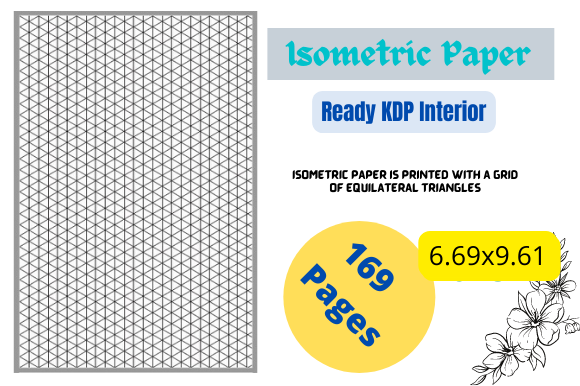
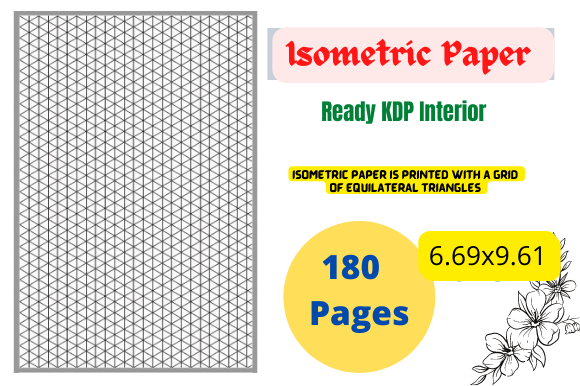
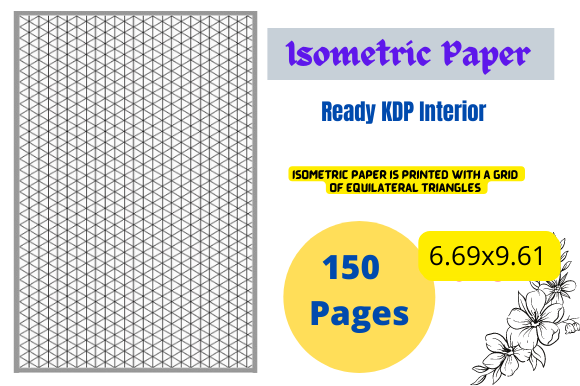
The defining characteristic of this specific isometric paper interior is its grid composition. It is printed with a network of equilateral triangles, each measuring exactly .28 inches. This specification is not arbitrary; it is a calculated dimension that bridges the gap between fine detail work and broad conceptual sketching. In isometric projection, the three axes are equally foreshortened, and the angles between them are always 120 degrees. The triangular grid provides the necessary scaffolding for these angles without requiring the user to constantly measure or use a protractor.
For KDP creators, the .28-inch measurement offers a distinct advantage over larger or smaller grids. A grid that is too large limits the amount of detail an artist can include in a sketch, making it unsuitable for intricate mechanical parts or architectural details. Conversely, a grid that is too small can become visually noisy, making it difficult to distinguish individual guide lines from the actual drawing. The .28 scale hits a "Goldilocks" zone, providing enough resolution for complex 3D printer planning while remaining open enough for landscape architecture and sculpture design. When preparing your Isometric Paper Interior for KDP Amazon, ensuring this grid consistency across every page is paramount for user satisfaction.
Bridging Digital Fabrication and Analog Planning
One of the most significant drivers of demand for isometric notebooks is the explosion of desktop 3D printing. While computer-aided design (CAD) software is the final destination for printable files, the ideation phase often happens away from the screen. Makers and engineers frequently find that sketching directly on isometric paper allows for faster iteration of concepts than manipulating vertices in a digital environment.
This analog-to-digital workflow is particularly prevalent in educational settings. Many colleges and high schools now offer 3D printing facilities and classes as part of their STEM or STEAM curricula. Students learning spatial reasoning benefit immensely from physical media that reinforces geometric concepts. An isometric notebook serves as both a sketchpad and a learning tool, helping students internalize how 3D forms translate to 2D representations. By targeting this demographic with a well-specified interior, publishers can tap into a recurring market of students and educators who require reliable tools for coursework and personal projects.
Artistic Applications: From Architecture to Escher-Style Illusions
Beyond engineering and education, isometric paper holds a special place in the art world. Architects and landscape designers have long relied on isometric projections to communicate spatial relationships without the distortion of perspective. Because isometric drawings maintain parallel lines, they allow for accurate scaling and measurement directly from the drawing, which is invaluable during the preliminary design phases of landscaping or structural planning.
Furthermore, there is a thriving community of artists dedicated to impossible geometry and optical illusions, heavily influenced by the work of M.C. Escher. These artists utilize the triangular grid to construct labyrinthine 3D images, infinite staircases, and paradoxical boxes. The strict geometry of the .28 equilateral triangle grid acts as a constraint that fuels creativity, allowing artists to focus on the logic of the illusion rather than the mechanics of drawing straight lines at correct angles. When marketing an Isometric Paper Interior for KDP Amazon, highlighting these artistic possibilities can broaden the appeal beyond technical users to include illustrators, puzzle designers, and recreational mathematicians.
Technical Specifications for KDP Success
Creating a successful low-content or medium-content book requires adherence to strict technical standards. The specific dimensions of 6.69 x 9.61 inches are strategically chosen for this interior. This size is slightly larger than the standard 6x9 trade paperback, offering additional canvas space for technical drawings where margins matter. However, it remains portable enough to fit in a bag for fieldwork or classroom use.
When preparing the file for upload, the following specifications must be met to ensure a seamless printing experience:
- Bleed PDF Settings: The interior file must be formatted as a Bleed PDF. Because the isometric grid extends to the edge of the page, the document size must include the extra bleed area (typically 0.125 inches on the top, bottom, and outside edges) to prevent white borders after trimming.
- Line Weight and Opacity: For isometric paper, line weight is critical. Lines that are too thick will overpower user sketches, while lines that are too faint may not print clearly. Testing various opacity levels during the proofing stage is essential to find the perfect balance where the grid is visible but unobtrusive.
- Single File Ready: Amazon KDP requires a single, consolidated PDF for the interior. Ensuring that all pages are correctly ordered and that the file is flattened can prevent processing errors.
- Content Originality: It is vital that all content is newly generated. Duplicate content flags can lead to publishing blocks. Creating a custom vector-based grid ensures uniqueness and superior print quality compared to rasterized or scraped templates.
Evaluating Suitability: Is This Interior Right for Your Project?
While isometric paper is versatile, it is not a universal replacement for other notebook types. Publishers and consumers should evaluate its suitability based on specific needs. If the primary goal is freehand life drawing or journaling, a blank or lined interior is superior. However, if the objective involves structured spatial thinking, the isometric format is unrivaled.
Consider the end-user's workflow. For a sculptor planning armature structures, the triangular grid helps visualize volume and mass. For a game designer creating isometric tile maps, the grid ensures assets align perfectly. For a geometry teacher explaining polyhedra, the pre-printed lines save valuable class time. The value proposition of this Isometric Paper Interior for KDP Amazon lies in its ability to reduce cognitive load. By outsourcing the geometric construction to the paper, the user is free to focus entirely on design and problem-solving.
Practical Expectations and Limitations
It is important to manage expectations regarding what isometric paper can and cannot do. Users accustomed to perspective drawing may initially find the lack of vanishing points disorienting. Isometric projection does not mimic human vision; it mimics technical reality. Therefore, this notebook is best positioned as a specialized tool rather than a general-purpose sketchbook.
Additionally, the .28-inch grid size, while versatile, may not suit every single application. Micro-engineering might require a finer grid, while large-scale site planning might prefer a coarser one. However, for the vast majority of 3D printing, architectural drafting, and artistic exploration, this specification offers the most balanced utility. Publishers should clearly state the grid size in their book description to ensure customers know exactly what they are purchasing, reducing returns and negative reviews.
Final Thoughts on Niche Publishing
The market for specialized notebooks continues to mature, rewarding creators who prioritize utility and quality over generic volume. An Isometric Paper Interior for KDP Amazon featuring a .28 equilateral triangle grid is more than just a collection of lines; it is a foundational tool for innovation. Whether facilitating the next generation of 3D printing engineers, assisting architects in visualizing sustainable spaces, or enabling artists to explore the boundaries of perception, this interior format delivers tangible value. By adhering to precise technical specifications like the 6.69x9.61 bleed-ready format and ensuring original, high-quality content, publishers can create resources that genuinely support the creative and technical endeavors of their audience. In doing so, they transform a simple notebook into an indispensable instrument of design.