Isometric Paper Interior for Kids: A Creative Design Tool
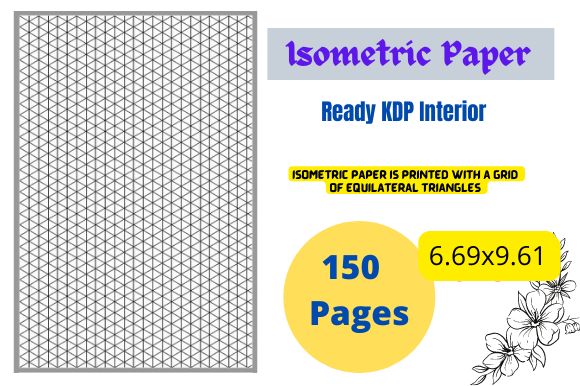
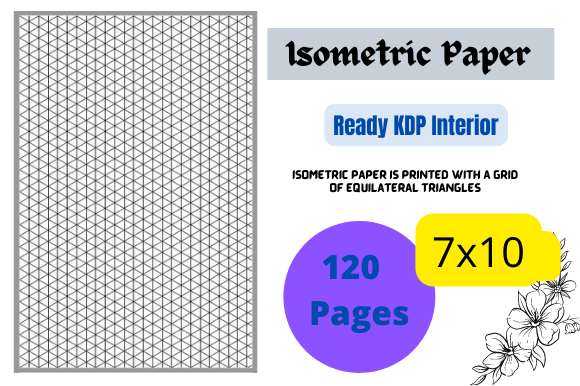
Spatial reasoning is a skill that benefits everyone, from young students just learning geometry to professional architects drafting complex structures. The Isometric Paper Interior for Kids provides a specialized canvas designed to bridge the gap between two-dimensional drawing and three-dimensional visualization. Unlike standard graph paper with square grids, this interior features a precise grid of equilateral triangles, each measuring .28 units. This specific measurement creates the perfect 30-degree axis alignment necessary for rendering depth without perspective distortion, making it an invaluable resource for anyone looking to explore spatial design in a tangible, screen-free format.
Understanding the Unique Grid Structure
The defining feature of this notebook interior is the equilateral triangle grid. While many isometric pads use larger grids suited for architectural blueprints, the .28 measurement offers a finer resolution. This density allows for greater detail in smaller spaces, which is particularly important when working within the 7x10 dimension. For users accustomed to standard quarter-inch or half-inch grids, this scale provides a satisfying balance between precision and usability. It is fine enough to render intricate mechanical parts or detailed pixel art but remains open enough to prevent visual clutter during the sketching phase.
This grid structure eliminates the need for vanishing points. In traditional perspective drawing, parallel lines converge at a horizon line, which can be difficult for beginners to master. On isometric paper, parallel lines remain parallel. This geometric consistency makes it significantly easier to visualize volume and proportion, reducing the cognitive load required to translate mental images onto paper. Whether you are sketching a simple cube or a complex labyrinthine structure, the grid acts as a built-in guide that maintains structural integrity throughout the drawing process.
Educational Value and Geometry Mastery
For educators and parents, this tool serves as a practical extension of mathematics and science curriculums. Geometry often feels abstract when confined to textbooks, but isometric drawing turns theoretical concepts into hands-on activities. Students can physically draw prisms, pyramids, and composite solids, gaining an intuitive understanding of faces, edges, and vertices. The .28 grid size is manageable for younger hands while still providing enough challenge for older students exploring advanced spatial relationships.
Beyond basic shapes, this paper supports lessons in topology and logic. Teachers can use it to introduce concepts like impossible objects or non-Euclidean geometry in an accessible way. Because the grid enforces consistent angles, students receive immediate visual feedback if their proportions are off, encouraging self-correction and critical thinking. This active learning approach helps solidify STEM concepts more effectively than passive observation, making the Isometric Paper Interior for Kids a versatile supplement to classroom instruction or homeschooling environments.
Bridging Analog Sketching and Digital Fabrication
The rise of desktop 3D printing has created a renewed demand for physical planning tools. Before committing to CAD software or slicing files, makers and hobbyists often find it faster to iterate ideas by hand. This notebook interior has become particularly popular for planning 3D printer projects because the isometric view closely mimics how objects appear in modeling software. Sketching directly on the .28 grid allows creators to work out dimensional constraints, assembly mechanisms, and aesthetic details before investing hours in digital modeling.
For those new to fabrication, this step reduces material waste and print failures. You can quickly test whether a bracket will fit in a designated space or if a decorative element looks proportional. Experienced designers also benefit from this analog stage; it encourages free-flowing ideation that mouse-and-keyboard workflows sometimes stifle. Many colleges and technical schools now incorporate hand-sketching into their 3D printing facilities and classes precisely because it strengthens the designer’s spatial intuition. Having a dedicated, portable notebook for this purpose ensures that inspiration can be captured immediately, regardless of proximity to a computer.
Artistic Exploration and Complex Illustrations
While highly functional for engineering, isometric paper is equally cherished by artists and illustrators. The style popularized by M.C. Escher relies heavily on isometric projection to create mind-bending puzzles, infinite staircases, and interlocking architectures. The .28 grid provides the scaffolding needed to construct these optical illusions with mathematical accuracy. Artists can focus on creativity and narrative rather than struggling to maintain consistent angles across a complex composition.
This medium is also excellent for game designers and world-builders. Creating tile-based maps, dungeon layouts, or cityscapes becomes streamlined when the underlying grid handles the perspective. Indie game developers often use isometric sketches to prototype level designs before coding. The compact 7x10 size makes it ideal for carrying to coffee shops or parks, allowing creative professionals to develop visual assets outside the studio. For illustrators working on children’s books or educational content, the clean, structured look of isometric art communicates information clearly while retaining a playful, engaging aesthetic.
Technical Specifications for Publishers and Creators
For independent publishers and content creators utilizing Amazon KDP, technical readiness is as important as content quality. This Isometric Paper Interior for Kids is generated specifically to meet platform requirements without additional formatting work. The file is a bleed-ready PDF sized at 7x10 inches, ensuring that the grid extends cleanly to the edge of the page after trimming. This eliminates common printing issues where margins shift or grids get cut off awkwardly.
- Dimensions: 7x10 inches, a versatile trim size that balances portability with ample drawing area.
- Grid Precision: Equilateral triangles at .28 units, optimized for detailed yet accessible sketching.
- File Format: Print-ready PDF with full bleed configuration.
- Content Originality: Newly generated interior with no duplicate content, ensuring compliance with platform uniqueness standards.
- Upload Status: Ready for immediate upload and printing without modification.
This specification set addresses the priorities of self-publishers who need reliability and speed. There is no need to hire a formatter or spend time adjusting margins. The content is unique, which protects against potential account flags related to duplicate interiors. For entrepreneurs building a brand around educational supplies or art journals, having a professionally prepared, niche-specific interior allows for faster product launches and consistent quality across titles.
Evaluating Fit for Your Specific Needs
Determining whether this specific isometric interior aligns with your goals requires considering your primary use case. If you are an architect needing large-scale site plans, the 7x10 size and .28 grid may be too small; you would likely prefer an 11x17 pad with a coarser grid. However, for concept sketching, journaling, or portable reference, this size is optimal. Beginners should appreciate the forgiving nature of the smaller grid, which makes mistakes less glaring and corrections easier to integrate into the pattern.
Educators should consider the age group they serve. While labeled "for kids," the .28 scale is sophisticated enough for middle school through college-level geometry and design courses. Younger children might benefit from practicing fine motor skills by tracing the existing lines before attempting freehand drawings. For 3D printing enthusiasts, evaluate the typical size of your prints; this grid excels at small-to-medium component design but may require taping multiple pages together for large assemblies.
Ultimately, the value of this tool lies in its specificity. It is not a generic notebook; it is a purpose-built instrument for spatial thinking. Whether you are teaching a child to see in three dimensions, prototyping your next 3D print, creating Escher-inspired art, or publishing a new line of activity books, the Isometric Paper Interior for Kids offers a precise, reliable foundation. By removing the friction of grid creation and perspective calculation, it frees up mental energy for what matters most: learning, creating, and innovating.