Mastering Spatial Design with Isometric Paper Interior for KDP: A Technical and Creative Guide
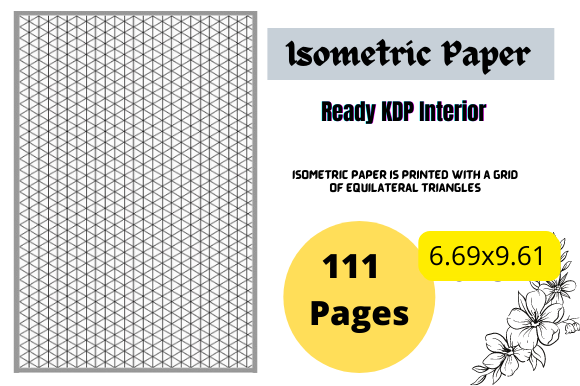
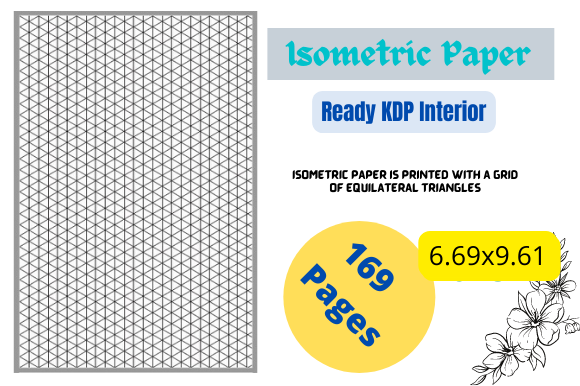
The transition from abstract thought to tangible representation often requires a bridge that standard lined or graph paper cannot provide. For creators publishing low-content books or professionals seeking precise drafting tools, the Isometric Paper Interior for KDP represents a specialized solution tailored for three-dimensional visualization. Unlike traditional orthogonal grids that force perspective distortion, isometric projection maintains equal scale across all axes, allowing for accurate spatial planning without the complexity of vanishing points. This specific interior format, printed with a grid of equilateral triangles measuring exactly 0.28 inches, serves as a foundational tool for architects, 3D printing enthusiasts, educators, and artists exploring complex geometric forms.
The Geometry of Equilateral Triangles in Spatial Drafting
Understanding why this specific paper works requires examining its underlying geometry. The grid consists of equilateral triangles with a side length of 0.28 inches. This measurement is not arbitrary; it creates a lattice where vertical lines remain truly vertical, while horizontal lines are projected at 30-degree angles to the left and right. This 30-degree isometric axis ensures that measurements taken along any of the three primary axes are consistent. When a user draws a cube on this surface, the top, left, and right faces appear identical in size and shape, eliminating the foreshortening found in linear perspective drawing.
The 0.28-inch spacing offers a distinct advantage over standard metric or imperial graph paper. It provides enough resolution for detailed mechanical sketches while remaining open enough to prevent visual clutter during conceptual brainstorming. For KDP publishers, this specific dimension translates cleanly to print production standards. The precision of the triangle grid allows users to sketch volumetric objects with mathematical accuracy, making it an indispensable resource for technical illustration where proportional integrity is paramount. The grid acts as a built-in ruler and protractor, guiding the hand to maintain structural coherence throughout the drawing process.
Applications in Additive Manufacturing and Engineering Education
One of the most significant modern use cases for isometric drafting lies in the rapidly expanding field of additive manufacturing. As schools and colleges increasingly integrate 3D printing facilities into their curricula, students and hobbyists require methods to visualize prints before committing to digital modeling software. While CAD programs are powerful, they can be unintuitive for initial ideation. Sketching directly on an Isometric Paper Interior for KDP notebook allows makers to troubleshoot geometry, plan support structures, and visualize layer adhesion issues in a tactile environment.
In educational settings, this paper bridges the gap between theoretical geometry and practical application. Students learning about volume, surface area, and spatial reasoning benefit from seeing how two-dimensional shapes assemble into three-dimensional solids. The triangular grid demystifies concepts like cross-sections and orthographic projection. For engineering educators, these notebooks serve as effective supplementary materials for courses in descriptive geometry and technical drawing. The ability to physically draw a part in isometric view helps reinforce mental rotation skills, which are critical for success in STEM fields. Furthermore, because the grid aligns with standard isometric projection standards used in industry, students develop transferable skills relevant to professional drafting environments.
Architectural Visualization and Landscape Planning
Professionals in architecture and landscaping utilize isometric grids to communicate design intent without the optical illusions inherent in perspective rendering. In landscape architecture, for instance, maintaining true scale is essential when arranging planting beds, hardscapes, and water features. Perspective drawings can make distant elements appear smaller than they are, potentially misleading clients about usable space. Isometric drawings preserve the actual footprint of every element, ensuring that a patio drawn in the background occupies the same visual weight as one in the foreground.
This fidelity makes the format ideal for site analysis and preliminary massing studies. Architects can quickly iterate through multiple spatial configurations, stacking volumes and testing circulation paths without setting up a digital model. The 0.28-inch triangle grid facilitates the drawing of modular components, such as brick patterns, tile layouts, and prefabricated structural elements. For interior designers, this paper aids in planning furniture arrangements and cabinetry where depth perception must be accurate rather than artistic. The resulting drawings function as both communication tools for clients and working references for contractors who need to understand spatial relationships clearly.
Exploring Escher-Style Art and Complex Labyrinths
Beyond technical utility, isometric paper has cultivated a niche within the artistic community, particularly among those inspired by the work of M.C. Escher. The rigid structure of the triangular grid paradoxically enables the creation of impossible objects and infinite loops. Artists use the predictable geometry to construct staircases that ascend and descend simultaneously, boxes that exist inside and outside themselves, and labyrinthine structures that defy Euclidean logic.
Creating this style of art requires a medium that enforces consistency. Freehand drawing of impossible geometry is exceptionally difficult because even minor deviations in angle break the illusion. The pre-printed equilateral triangles act as a scaffold, ensuring that every line adheres to the necessary 30-degree or 90-degree orientation. This allows artists to focus on the conceptual puzzle rather than the mechanical execution. For KDP creators targeting the adult coloring book or puzzle market, interiors featuring blank isometric grids offer users a canvas for meditative, structured creativity. The repetitive nature of filling in isometric blocks can also serve as a therapeutic exercise, combining mindfulness with spatial problem-solving.
Technical Specifications for Seamless KDP Integration
For self-publishers and content creators, the viability of an Isometric Paper Interior for KDP depends heavily on adherence to platform specifications. This particular interior is engineered with dimensions of 6.69 x 9.61 inches, a trim size that balances portability with adequate drawing surface area. This non-standard size distinguishes products in a marketplace saturated with generic 8.5x11 or 6x9 options, offering users a unique form factor that feels substantial yet manageable.
Critical to the production quality is the inclusion of bleed settings in the PDF file. Grid lines extending to the edge of the page must account for trimming variance during the printing process. A properly prepared bleed PDF ensures that no white margins appear where the grid should extend to the cut line, preserving the immersive experience for the user. The specification of "1 File Ready Interior" indicates that the document has been flattened and optimized for print-on-demand workflows, eliminating common upload errors related to transparency, color profiles, or font embedding.
Furthermore, the assurance of new, non-duplicate content is vital for long-term account health. Amazon’s algorithms actively penalize repetitive or mass-produced low-content interiors. By utilizing freshly generated grid files, publishers mitigate the risk of rejection or shadow-banning. The uniqueness of the 0.28-inch triangle spacing further differentiates the product from competitors using generic vector assets. This attention to technical detail transforms a simple notebook into a professional-grade tool that meets the exacting standards of both the printing platform and the end-user.
Comparative Advantages Over Digital Alternatives
Despite the prevalence of tablets and stylus-enabled devices, physical isometric paper retains distinct cognitive and practical benefits. Digital apps often include auto-correct features or snap-to-grid functions that, while convenient, can interrupt the flow of organic ideation. Physical paper demands intentionality; every line is a commitment. This friction encourages deeper engagement with the spatial problem at hand. Research in design pedagogy suggests that analog sketching activates different neural pathways associated with spatial memory and conceptual synthesis compared to digital input.
Additionally, physical notebooks eliminate battery anxiety, software updates, and compatibility issues. They are universally accessible tools that do not require proprietary hardware. For fieldwork in construction, landscaping, or archaeological documentation, a durable notebook withstands environmental conditions that would damage sensitive electronics. The immediate feedback of graphite on paper also provides tactile information about pressure and speed that glass screens cannot replicate. For KDP sellers, emphasizing these analog advantages in product descriptions helps position the Isometric Paper Interior for KDP not as a relic, but as a deliberate choice for focused, distraction-free creation.
Optimizing Content Strategy for Niche Markets
Success with isometric interiors on KDP requires understanding the diverse segments that utilize this tool. Marketing efforts should address the specific pain points of each group. For the 3D printing community, highlight the grid's compatibility with layer height calculations and prototype planning. For educators, emphasize alignment with geometry standards and STEM learning objectives. For artists, showcase examples of Escher-style constructions and impossible geometry tutorials.
Creators can also enhance value by including introductory pages that explain how to use the grid effectively. Simple diagrams demonstrating how to draw basic cubes, cylinders, and pyramids on the 0.28-inch triangle lattice can significantly increase the perceived utility of the book. Including conversion charts or scale references adds professional polish. By treating the interior not just as blank pages but as a guided instrument for spatial thinking, publishers can command higher price points and foster greater customer loyalty. The specificity of the 6.69x9.61 dimension and the unique triangle size provides natural keywords and selling points that resonate with searchers looking for precision tools rather than generic sketchbooks.