Evaluating the KDP Isometric Paper Interior 6.69x9.61 for Technical and Creative Projects
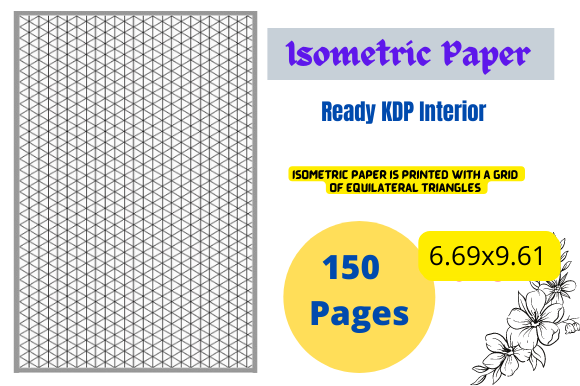
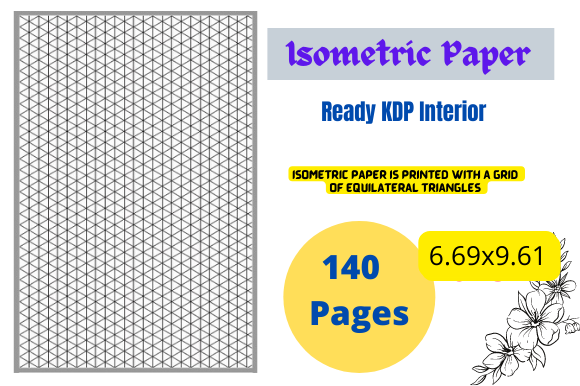
Selecting the correct paper format is often the foundational step in any successful design or educational project. For creators, educators, and engineers utilizing Amazon’s Kindle Direct Publishing (KDP) platform to distribute physical notebooks, the specific dimensions and grid specifications matter significantly. The KDP Isometric Paper Interior 6.69x9.61 represents a specialized niche within low-content publishing. Unlike standard graph paper or dot grids, this interior features a precise grid of equilateral triangles, each measuring exactly .28 inches. This specification transforms a simple notebook into a functional tool for three-dimensional visualization, architectural planning, and complex geometric exploration.
Understanding the utility of this specific interior requires looking beyond mere aesthetics. The .28-inch triangle grid is engineered to facilitate isometric projection, a method of graphic representation where three coordinate axes appear equally foreshortened. For professionals and students aged 20 to 50 who are evaluating resources for 3D printing, sculpture, or advanced mathematics, this pre-formatted PDF offers a distinct advantage over generic alternatives. However, determining whether this specific size and grid density aligns with your project goals requires a balanced assessment of its strengths, limitations, and best-fit scenarios compared to other drafting solutions.
Technical Specifications and Practical Utility
The primary differentiator of the KDP Isometric Paper Interior 6.69x9.61 is the precision of its underlying geometry. Each equilateral triangle measures .28 inches, creating a consistent lattice that supports accurate spatial reasoning. In isometric drawing, vertical lines remain vertical, while horizontal lines are drawn at 30-degree angles. The triangular grid eliminates the need for manual angle measurement, allowing users to focus entirely on form and proportion rather than setup mechanics.
The dimensions, 6.69 by 9.61 inches, are not arbitrary. This size sits comfortably between the standard A5 and US Letter sizes, offering a portable yet spacious canvas. It provides sufficient surface area for detailed technical sketches without becoming cumbersome to carry in a field bag or laptop case. For KDP publishers, this trim size is optimized for bleed settings, ensuring that the grid extends cleanly to the edge of the page when printed. The file is generated as a print-ready PDF, eliminating common formatting errors such as margin shifts or resolution loss that can occur when resizing generic templates.
Applications in 3D Printing and Engineering
One of the most significant modern use cases for this specific isometric grid is planning for additive manufacturing. As colleges and maker spaces increasingly integrate 3D printing into their curricula and workflows, the bridge between digital modeling and physical output remains critical. While CAD software dominates the final production phase, initial conceptualization often benefits from analog tools.
- Rapid Prototyping: Sketching directly on a .28-inch grid allows designers to estimate volume and structural integrity before committing to digital modeling.
- Spatial Troubleshooting: Visualizing support structures and overhangs is often more intuitive on paper during the brainstorming phase than rotating a model on a screen.
- Communication: Isometric sketches serve as a universal language between team members who may have varying levels of CAD proficiency.
For users specifically focused on 3D printing, the .28-inch scale offers a practical balance. It is large enough to draw recognizable mechanical parts and enclosure designs but small enough to maintain detail. Compared to larger engineering pads, the 6.69x9.61 format encourages concise iteration, prompting users to refine ideas quickly rather than getting lost in excessive detail during the concept phase.
Comparative Analysis: Isometric vs. Alternative Grids
When researching notebook interiors, it is essential to distinguish isometric paper from similar-looking options. Confusion often arises between isometric, orthographic, and perspective grids. Understanding these differences prevents purchasing the wrong tool for a specific task.
Isometric vs. Perspective Grids: Perspective grids utilize vanishing points to create realistic depth, mimicking how the human eye sees. They are ideal for artistic rendering and architectural visualization where realism is paramount. In contrast, the KDP Isometric Paper Interior 6.69x9.61 maintains parallel lines indefinitely. There is no convergence. This makes it superior for technical diagrams, assembly instructions, and measurable designs where relative scale must remain constant across the entire image. If your goal is photorealism, this is not the right choice; if your goal is measurable accuracy and uniform representation, isometric is superior.
Isometric vs. Standard Graph Paper: Traditional square grid paper excels at 2D plotting and orthogonal views. However, attempting to draw 3D objects on square grids requires constant mental translation or the use of protractors. The triangular grid of this KDP interior automates the 30-degree axis alignment. For geometry students or artists exploring volumetric forms, the cognitive load is significantly reduced, allowing for faster skill acquisition and more fluid creative expression.
Evaluating Digital Alternatives
A valid question for modern users is whether physical isometric paper remains relevant given the availability of tablets and stylus-enabled apps. Digital tools offer undo functions, layers, and instant sharing. However, the KDP Isometric Paper Interior 6.69x9.61 serves a complementary role rather than a competitive one.
Analog sketching promotes a different type of thinking. The tactile feedback of pen on paper and the inability to instantly erase encourage commitment to lines and holistic composition. Many professionals find that starting on physical isometric paper reduces "screen fatigue" and prevents premature fixation on minor digital details. Furthermore, for educators teaching geometry or spatial reasoning, physical paper ensures all students operate on an identical, standardized baseline without software compatibility issues or device disparities. The decision often comes down to workflow preference: digital for refinement and presentation, physical isometric paper for ideation and fundamental learning.
Strengths and Tradeoffs of the 6.69x9.61 Format
No single product fits every scenario. Evaluating the tradeoffs of this specific KDP interior helps determine if it aligns with your current needs.
Key Advantages
- Specialized Precision: The .28-inch equilateral triangle specification is difficult to replicate accurately with home printers due to calibration variances. A professionally printed KDP interior guarantees consistency across every page.
- Portability: The 6.69x9.61 footprint is highly mobile. It fits in standard bags and allows for field work in landscaping or site analysis where larger drafting tables are impractical.
- Versatility: Beyond engineering, the grid supports artistic endeavors like MC Escher-style impossible objects, labyrinthine puzzles, and complex tiling patterns, appealing to a broader demographic than pure technical users.
- Ready-to-Use: For publishers, the bleed-ready PDF eliminates hours of formatting adjustments, reducing time-to-market for niche stationery products.
Potential Limitations
Despite its utility, this format has constraints. The .28-inch grid size is fixed. Users requiring larger scales for landscape architecture master plans or smaller scales for intricate jewelry design may find this specific measurement limiting. Additionally, isometric projection inherently distorts true shape; circles become ellipses, and angles are not represented in their true magnitude. Users accustomed to orthographic projection must retrain their visual interpretation.
Furthermore, the 6.69x9.61 size, while portable, offers less total workspace than an 8.5x11 sheet. Complex assemblies requiring extensive annotation or multiple views may feel cramped. In such cases, users might need to supplement this notebook with larger format paper for final documentation, using the KDP interior strictly for preliminary studies.
Making an Informed Selection Decision
Choosing the KDP Isometric Paper Interior 6.69x9.61 should be driven by specific project requirements rather than general interest. It is the optimal choice when:
- You are engaged in 3D printing preparation and need a quick, measurable way to visualize layer stacking and support needs.
- You are teaching or studying solid geometry and require a standardized aid for understanding volumetric relationships.
- You are an artist exploring impossible geometry or optical illusions and need a reliable underlying structure to maintain visual coherence.
- You are a publisher seeking a niche, high-utility interior that serves a defined audience of makers and students without requiring custom design work.
Conversely, consider alternative formats if your primary focus is photorealistic rendering, large-scale site planning, or purely 2D data plotting. The value of this specific isometric interior lies in its specialization. By providing a dedicated space for three-dimensional thinking in a portable, standardized format, it fills a gap between casual sketchbooks and professional drafting equipment. Whether used for designing the next generation of printed mechanisms or exploring the mathematical beauty of tessellations, this interior offers a structured foundation for spatial creativity.