Isometric Paper KDP Interiors: Strategic Value for Technical Publishing and Creative Design
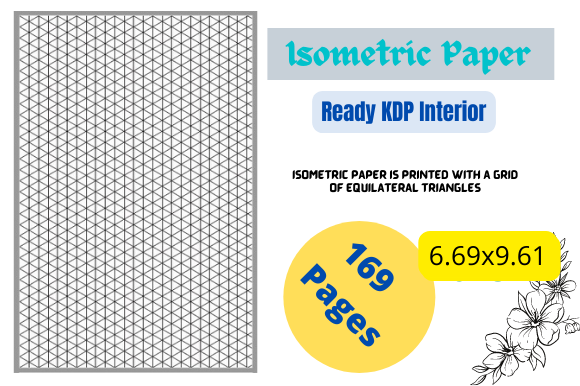
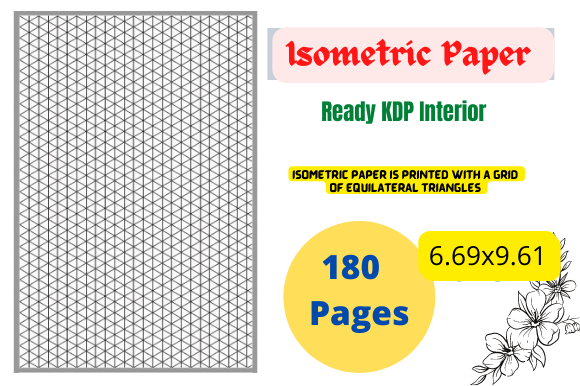
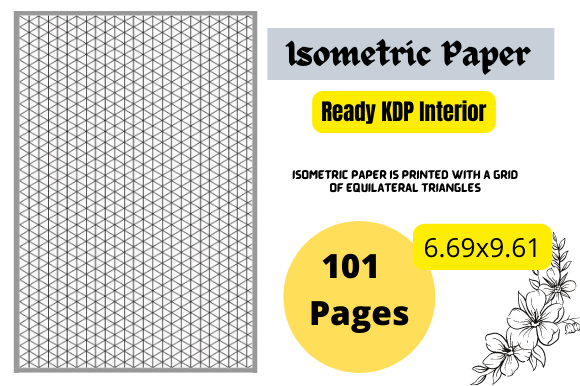
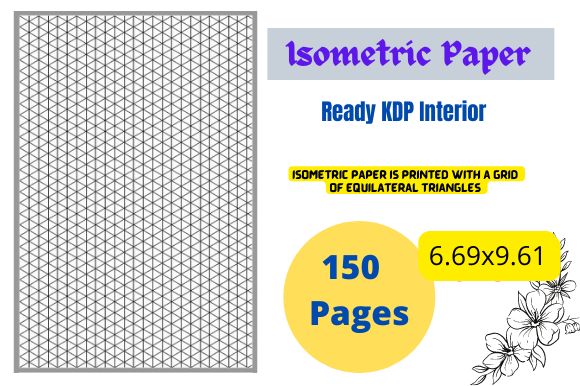
For self-publishers, educators, and technical professionals, the quality of a notebook interior dictates its utility and market viability. Isometric Paper KDP Interiors serve a specialized niche that standard lined or graph paper cannot address. This specific format features a grid of equilateral triangles, typically measuring .28 inches per side, creating a precise framework for three-dimensional representation. Unlike perspective drawing which relies on vanishing points and foreshortening, isometric projection maintains parallel lines and consistent scale. This makes it an essential tool for architecture, landscaping, sculpture, engineering, and the rapidly growing field of 3D printing design.
When developing or selecting Isometric Paper KDP Interiors, the strategic focus must be on precision and end-user application. The value proposition lies in the accuracy of the grid and the physical dimensions of the book. A specification of 6.69x9.61 inches offers a versatile canvas that balances portability with adequate workspace for detailed schematics. For publishers and creators, understanding the technical nuances of this interior type is critical to producing a resource that professionals and students will actually use rather than discard. It transforms a simple notebook into a functional instrument for spatial reasoning and project planning.
The Functional Advantage of Equilateral Triangle Grids
The core differentiator of high-quality Isometric Paper KDP Interiors is the geometric integrity of the grid. Each triangle measuring .28 inches provides a dense enough resolution for detailed work without creating visual clutter. This specific measurement allows users to plot coordinates and dimensions with greater fidelity than larger grids, while remaining distinct enough to prevent eye strain during extended drafting sessions. For architects and landscape designers, this grid facilitates the rapid visualization of structures and terrain without the distortion inherent in traditional perspective sketches.
In educational settings, particularly within geometry and STEM curricula, this paper bridges the gap between abstract mathematical concepts and tangible spatial understanding. Students learning about volume, surface area, and spatial relationships benefit from a structured environment where 3D forms can be rendered accurately. When colleges and schools integrate 3D printing facilities into their programs, the demand for analog planning tools increases. Before committing to a digital CAD model, designers often need to sketch ideas quickly. Isometric paper allows for this iterative brainstorming phase, serving as a low-friction interface between imagination and digital fabrication.
Supporting 3D Printing and Technical Workflows
The rise of additive manufacturing has created a renewed relevance for isometric drafting. While software handles the final execution, the conceptualization phase often requires manual iteration. Isometric Paper KDP Interiors provide the necessary scaffolding for planning 3D printer projects. Designers can visualize layer stacking, support structures, and assembly tolerances in a way that mimics the actual printing process. This analog step reduces errors in the digital modeling phase by forcing the creator to consider physical constraints early in the design cycle.
For entrepreneurs and product developers, using this specialized paper supports better decision-making during the prototyping stage. It encourages thinking in terms of volume and structure rather than mere appearance. When planning a new product enclosure or mechanical part, the ability to sketch accurate isometric views helps communicate intent to engineers and stakeholders more effectively than vague freehand drawings. This clarity can reduce revision cycles and accelerate time-to-market. The paper acts as a communication protocol, ensuring that spatial ideas are conveyed with technical accuracy before resources are invested in digital modeling.
Creative Applications and Cognitive Engagement
Beyond technical utility, Isometric Paper KDP Interiors unlock unique creative possibilities that appeal to artists and puzzle designers. The grid naturally lends itself to the creation of impossible objects, labyrinthine staircases, and complex interlocking structures reminiscent of M.C. Escher. This artistic application is not merely recreational; it represents a rigorous exercise in spatial logic and cognitive flexibility. For creators publishing activity books or art journals, offering a high-precision isometric grid adds significant perceived value compared to generic alternatives.
This duality of purpose—technical precision and creative exploration—expands the potential audience for KDP interiors. Marketers and publishers should position these notebooks to address both segments. For the technical user, emphasize accuracy, scale, and compatibility with 3D printing workflows. For the creative user, highlight the freedom to explore optical illusions and complex geometries. Understanding these distinct user intents allows for more effective keyword targeting and product description writing, ensuring the right book reaches the right buyer.
Strategic Considerations for KDP Publishers
Producing viable Isometric Paper KDP Interiors requires attention to production specifications that go beyond the grid itself. The 6.69x9.61 inch dimension is strategically chosen to maximize print efficiency and usability. It is large enough to accommodate substantial diagrams yet compact enough to fit in a bag alongside a laptop or tablet. Publishers must ensure that the bleed PDF is correctly formatted to prevent grid lines from being truncated during trimming. A "ready interior" file must account for the gutter margin, ensuring that the triangular grid remains usable all the way to the binding. Failure to manage this whitespace renders the inner portion of the page useless for precise drafting.
Content originality is another critical factor. With the KDP marketplace saturated with low-effort duplicates, generating new, unique content is essential for long-term visibility and compliance. Algorithms and customers alike favor products that demonstrate genuine utility and fresh presentation. This might involve varying the grid density, adding specialized headers for project metadata, or including reference guides for isometric scaling. Simply re-uploading public domain templates is a race to the bottom. Investing in newly generated, professionally specified interiors builds a defensible catalog that stands up to scrutiny and delivers consistent sales performance.
Risks and Intentional Implementation
While Isometric Paper KDP Interiors are powerful tools, they are not universally applicable. Relying on them without clear context can lead to frustration. Users accustomed to orthogonal graph paper may initially struggle with the 30-degree axis alignment required for true isometric drawing. Publishers and educators should consider this learning curve. Including a brief instructional page or examples of basic isometric shapes can significantly enhance user adoption and satisfaction. Without this guidance, the paper may be perceived as difficult or unintuitive, leading to negative reviews and returns.
There is also the risk of over-specialization. If the target audience is too narrow, sales volume may not justify the effort. Decision-makers must validate demand before scaling production. Analyze search trends for related terms like "3D printing sketchbook," "isometric drawing pad," or "geometry workbook." Ensure that the specific .28-inch triangle size aligns with industry standards or educational requirements in your target market. A grid that is too fine or too coarse for standard drafting scales will fail to meet professional expectations. Validation through community feedback or small-batch testing is a prudent step before committing to large-scale marketing campaigns.
Enhancing Long-Term Value Through Quality
The longevity of a KDP business depends on reputation and repeat customers. For Isometric Paper KDP Interiors, quality is defined by print clarity and paper performance. Faint or broken grid lines destroy the utility of the book. Ink bleed-through prevents double-sided use, which is often necessary for comprehensive project documentation. While authors cannot control Amazon’s print quality directly, they can optimize files to mitigate common issues. Using appropriate line weights and avoiding solid black backgrounds helps maintain grid legibility across different printing facilities.
Furthermore, thoughtful positioning extends the lifecycle of the product. Rather than marketing it solely as a disposable sketchpad, frame it as a permanent reference tool or portfolio component. Encourage users to date their entries and treat the book as a record of their design evolution. This shifts the perception from a commodity to a valued asset. For educators, it becomes a curriculum companion; for professionals, a project archive. By embedding the product into the user's long-term workflow, you create stickiness that transcends seasonal trends and algorithmic fluctuations.
Ultimately, success with Isometric Paper KDP Interiors stems from respecting the user's need for precision and functionality. It is not enough to simply provide a grid; one must provide a solution to a spatial problem. Whether facilitating the next generation of 3D printed innovations, teaching fundamental geometry, or enabling complex artistic expression, the interior must perform flawlessly. Adhering to strict specifications like the 6.69x9.61 bleed-ready format and ensuring content originality are baseline requirements. The true competitive advantage comes from understanding the intersection of analog drafting and modern digital creation, and delivering a product that honors both traditions with equal rigor.