Isometric Paper KDP Interiors for 3D Design
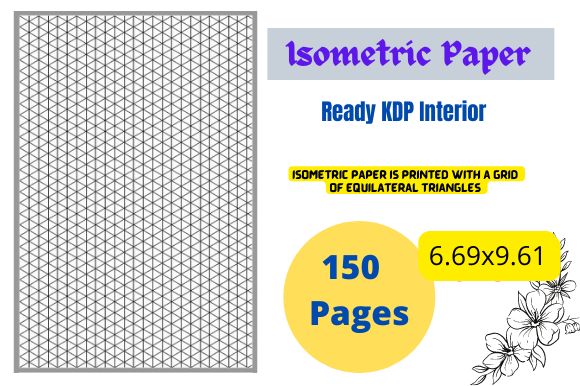
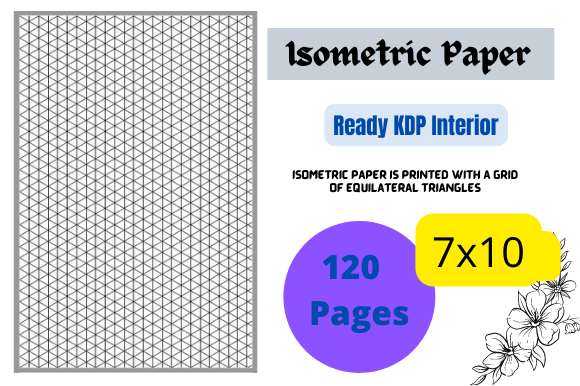
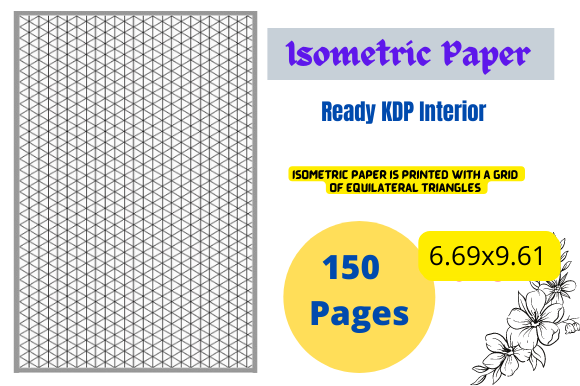
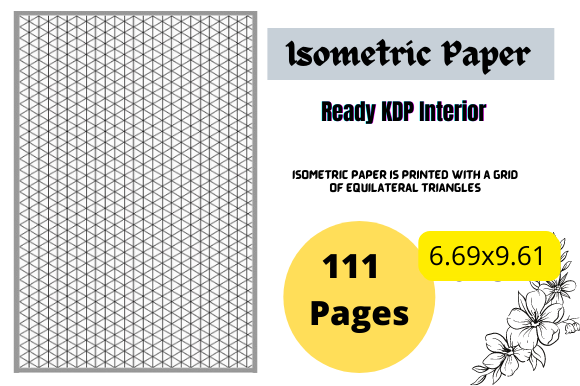
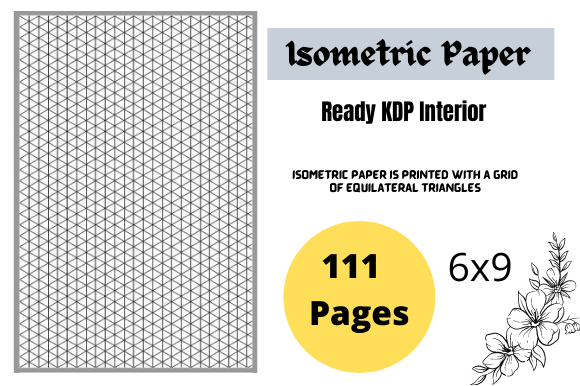
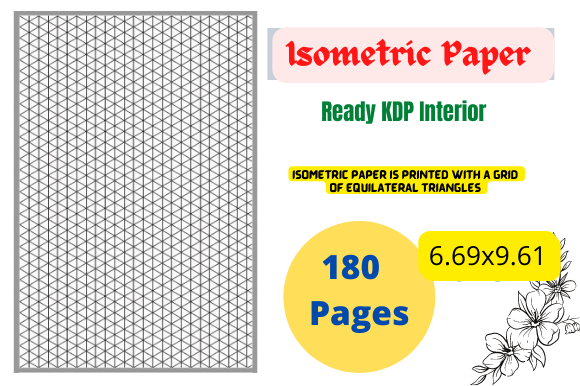
Precision in three-dimensional sketching often comes down to the quality of the underlying guide. Isometric Paper KDP Interiors provide a specialized foundation for creators who need to visualize depth, structure, and spatial relationships without relying on digital software. Unlike standard graph paper that uses squares, this specific interior is printed with a grid of equilateral triangles, each measuring exactly .28 units. This precise geometric framework creates a 30-degree axis system that naturally guides the hand toward accurate isometric projection, making it an essential tool for anyone working in architecture, landscaping, sculpture, or technical illustration.
For self-publishers and low-content book creators, understanding the specific utility of this grid is vital. It is not merely a novelty; it serves a functional purpose for a dedicated niche of users. Whether you are designing a workbook for engineering students, a sketchbook for concept artists, or a planning journal for 3D printing enthusiasts, the value lies in the accuracy of the triangle size and the clarity of the print. This interior transforms a blank notebook into a professional-grade drafting instrument.
The Technical Advantage of the .28 Triangle Grid
The defining feature of this interior is the measurement of the equilateral triangles. At .28 units, the grid strikes a balance between fine detail and broad structural planning. A grid that is too dense can become visually noisy, making it difficult to distinguish the drawing from the guidelines. Conversely, a grid that is too sparse forces the user to estimate proportions, defeating the purpose of using isometric paper. The .28 specification offers a "Goldilocks" zone that supports both intricate mechanical parts and larger architectural forms.
This specific triangulation allows for consistent scaling. When drawing cubes, cylinders, or complex polyhedrons, the vertices align perfectly with the grid intersections. For professionals and hobbyists alike, this reduces cognitive load. Instead of calculating angles or worrying about perspective distortion, the user can focus entirely on form and function. The grid acts as a silent collaborator, ensuring that vertical lines remain truly vertical and receding lines maintain the correct isometric angle throughout the entire page.
Applications in Architecture and Landscaping
Architects and landscape designers frequently turn to isometric sketches during the ideation phase. While CAD software dominates final production, the initial spark of a design often happens on paper. Isometric Paper KDP Interiors allow these professionals to quickly iterate on spatial concepts. Because isometric projection preserves scale along all three axes, it provides a more measurable representation than traditional perspective drawing. A landscape architect can sketch a garden layout where the relative sizes of trees, pathways, and structures remain proportional, allowing for immediate visual assessment of density and flow.
For those in urban planning or interior design, this paper facilitates communication with clients who may struggle to read 2D floor plans. An isometric sketch bridges the gap between technical blueprints and realistic rendering. It presents a 3D view that is easy to understand while retaining the precision needed for professional evaluation. Using a pre-printed KDP interior ensures that every sketch maintains a consistent standard, which is particularly useful when compiling a portfolio or presenting multiple options to a stakeholder.
Supporting the 3D Printing Workflow
One of the most rapidly growing audiences for isometric paper is the 3D printing community. As schools, colleges, and makerspaces increasingly offer 3D printing facilities, the need for analog planning tools has surged. Before committing to a digital model, many designers prefer to sketch their ideas physically. This step is crucial for identifying potential structural weaknesses, overhang issues, or aesthetic imbalances that might be overlooked in a virtual environment.
The .28 triangle grid is particularly well-suited for FDM (Fused Deposition Modeling) and SLA (Stereolithography) project planning. Makers can draw modular components, enclosures, or replacement parts with confidence that the dimensions will translate to the build plate. For educators teaching 3D design, notebooks featuring Isometric Paper KDP Interiors serve as excellent instructional aids. They help students develop spatial reasoning skills before they ever touch a mouse or stylus. By grounding digital fabrication in physical geometry, learners gain a deeper intuitive understanding of how objects occupy space.
Creative Exploration and Escher-Style Art
Beyond technical applications, isometric paper is a playground for artists interested in optical illusions and impossible geometry. The style popularized by M.C. Escher relies heavily on the isometric grid to create labyrinthine images featuring interlocking staircases, paradoxical boxes, and infinite loops. The rigid structure of the .28 triangle grid provides the necessary scaffolding for these mind-bending compositions.
Artists and puzzle designers use this paper to construct complex visual riddles. The grid ensures that the "impossible" elements still adhere to a consistent internal logic, which is what makes the illusion convincing. For creators producing coloring books, activity journals, or art instruction guides, this interior adds significant perceived value. It signals to the buyer that the book was designed specifically for this type of creative work, rather than being a generic sketchpad. The uniformity of the triangles allows for tiling patterns and tessellations that would be nearly impossible to draw freehand with such precision.
Educational Value in Geometry and Mathematics
In academic settings, isometric paper is a fundamental resource for teaching solid geometry. Students learning about volume, surface area, and cross-sections benefit immensely from being able to visualize 3D shapes on a 2D surface. The equilateral triangle grid helps demystify abstract mathematical concepts by providing a tangible reference frame. When a student draws a prism or a pyramid on this paper, the relationship between faces, edges, and vertices becomes immediately apparent.
For tutors and curriculum developers creating supplemental materials, Isometric Paper KDP Interiors offer a cost-effective way to produce high-quality practice books. Rather than asking students to draw their own grids—which wastes time and introduces error—educators can provide ready-to-use pages. This efficiency maximizes learning time and ensures that assessments focus on geometric understanding rather than drafting ability. The .28 size is legible enough for younger students while remaining precise enough for advanced college-level coursework.
Specifications for KDP Publishing Success
When integrating this content into a KDP project, adhering to technical specifications is non-negotiable. This interior is formatted at 6.69 x 9.61 inches, a versatile trim size that offers ample drawing area while remaining portable. It is supplied as a bleed PDF, meaning the grid extends to the very edge of the page. This is critical for isometric paper; a white margin breaking the grid pattern disrupts the continuity needed for large drawings and looks unprofessional.
The file is generated as new content with no duplicates, ensuring compliance with Amazon’s quality standards. Duplicate or recycled interiors are frequently flagged and rejected, so using freshly generated files protects your publishing account. The single-file format simplifies the upload process, reducing the friction between creation and publication. For publishers evaluating different interiors, prioritize those that guarantee crisp line weight and consistent spacing. A blurry or uneven grid renders the paper useless for precision work. This specific .28 triangle interior is optimized for print clarity, ensuring that the guidelines are visible but unobtrusive, allowing pencil, pen, or marker work to stand out clearly.
Evaluating Fit for Your Project
Determining whether Isometric Paper KDP Interiors are right for your next publication depends on your target audience's specific workflow. If your readers are primarily engaged in freeform artistic expression or journaling, a dot grid or blank page may be more appropriate. However, if your niche involves structured visualization, technical planning, or geometric art, the equilateral triangle grid is unmatched in utility.
Consider the skill level of your users as well. Beginners often find the .28 grid forgiving and educational, while professionals appreciate its efficiency for rapid prototyping. Business owners and marketers in the maker space should recognize that this interior solves a specific pain point: the lack of affordable, high-quality analog planning tools for 3D design. By aligning your product with the practical needs of architects, students, artists, and engineers, you move beyond selling a generic notebook and start offering a specialized tool that facilitates real-world creation.