Interior Isometric Paper: A Practical Tool for 3D Design and KDP Publishing
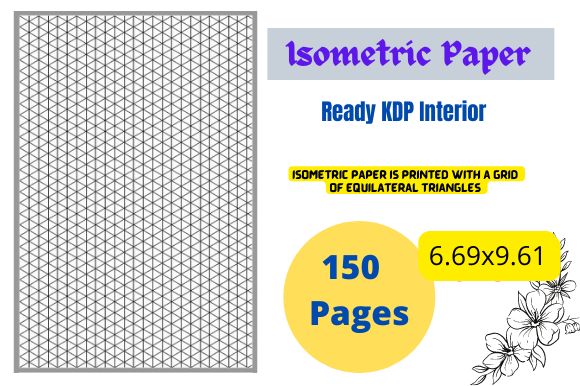
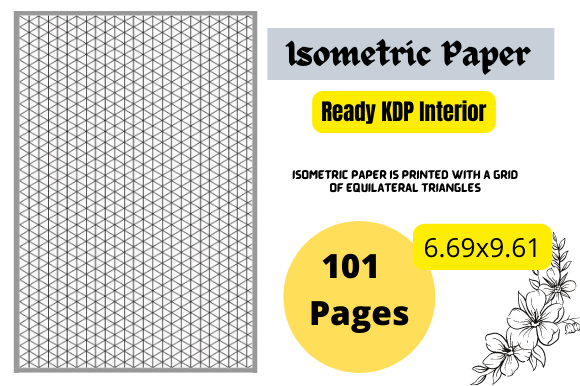
When you need to visualize depth without the distortion of traditional perspective, interior isometric paper provides an immediate structural advantage. Unlike standard graph paper that confines ideas to two dimensions, this specialized medium features a precise grid of equilateral triangles, each measuring exactly .28 units. This specific measurement creates a consistent 30-degree angle framework that allows designers, artists, and students to sketch three-dimensional objects with mathematical accuracy. For creators looking to publish low-content books via Amazon KDP or professionals needing a reliable drafting surface, understanding the practical application of this grid is essential for producing high-quality, functional work.
The Precision of the .28 Triangle Grid
The defining characteristic of this paper is not just the presence of triangles, but their specific scale. The .28 measurement offers a "Goldilocks" density for most handheld drafting tasks. If the grid were larger, intricate details would become impossible to render; if smaller, the page would look cluttered and overwhelm the design. At .28, the grid lines are visible enough to guide your hand but subtle enough to recede into the background once ink or graphite is applied.
This scale is particularly effective for maintaining proportion. When drawing cubes, architectural forms, or mechanical parts, the equilateral triangle ensures that all vertical lines remain truly vertical while horizontal axes diverge at perfect 30-degree angles. This eliminates the guesswork often associated with freehand isometric drawing. For users transitioning from digital CAD software back to analog sketching, this grid mimics the snap-to-grid functionality they are accustomed to, making the mental translation from screen to paper seamless.
Bridging Analog Sketching and 3D Printing
One of the most significant modern use cases for interior isometric paper is in the planning phase of 3D printing projects. While slicer software handles the final fabrication, the initial conceptualization often happens away from the computer. Makers and hobbyists find that sketching directly on an isometric grid helps identify structural weaknesses before committing hours to a print.
Consider a scenario where you are designing a custom bracket or enclosure. On plain paper, it is difficult to judge wall thickness or overhang angles accurately. On isometric paper, you can draw the object to scale using the .28 grid as a unit of measurement. This visual planning step reduces failed prints and wasted filament. Many college engineering programs and maker spaces now integrate this analog planning step into their curriculum because it forces students to think spatially rather than relying solely on software to solve geometry problems. The paper acts as a sanity check for digital designs, ensuring that what looks good on a monitor is actually buildable in physical space.
Architectural and Landscape Visualization
For architects and landscapers, isometric projection offers a unique communication tool. Traditional perspective drawings can be misleading due to vanishing points that distort size relationships. Isometric drawings, by contrast, maintain consistent scale throughout the image. This makes interior isometric paper invaluable for client presentations where accurate spatial understanding is required.
In landscaping, this grid excels at plotting garden beds, hardscaping, and outdoor furniture arrangements. Because plants and structures are drawn without foreshortening, clients can better understand the actual footprint of a design. An architect might use the .28 grid to quickly iterate through multiple room layouts during a consultation, sketching modular furniture or partition walls that align perfectly with the underlying geometry. This rapid visualization capability turns abstract discussions into tangible plans in real-time, bridging the gap between professional expertise and client comprehension.
Creative Applications: Escher-Style Art and Puzzles
Beyond technical utility, this paper serves as a playground for artistic exploration. The style popularized by M.C. Escher—featuring impossible staircases, interlocking shapes, and labyrinthine architecture—is naturally supported by the isometric grid. Artists who create optical illusions or complex puzzle boxes rely on the strict geometric foundation to sell the illusion. Without the guiding lines of the equilateral triangles, maintaining the consistency required for "impossible" art becomes exponentially more difficult.
This creative niche has seen a resurgence alongside the adult coloring book and activity book market. Creators are using this specific interior file to produce puzzle books, maze collections, and mindfulness drawing guides. The structured nature of the grid provides a meditative framework for users, allowing them to engage in creative flow without the anxiety of a blank page. For KDP publishers, this represents a viable product category where the utility of the paper itself is the primary value proposition.
Educational Value in Geometry and Spatial Reasoning
Educators teaching geometry, technical drawing, or STEM subjects utilize this paper to develop spatial reasoning skills in students. Understanding how 3D objects translate to 2D representations is a fundamental cognitive skill. The .28 triangle grid provides a tactile learning aid that reinforces concepts like volume, surface area, and axial alignment.
In classroom settings, the consistency of the grid allows for standardized assignments where student work can be easily assessed against objective geometric criteria. Whether calculating the volume of a composite solid or practicing orthographic projection, the paper removes the barrier of drawing straight lines at correct angles, letting students focus entirely on the mathematical concepts. Homeschoolers and tutors also find this resource useful for creating custom worksheets that differ from generic textbook exercises, providing targeted practice for learners struggling with spatial visualization.
KDP Publishing Specifications and Quality Assurance
For entrepreneurs and self-publishers, the technical specifications of this interior file are designed for immediate production. The dimensions of 6.69 x 9.61 inches correspond to standard international paper sizes, making it versatile for global distribution. Crucially, the file includes proper bleed settings, ensuring that the grid extends cleanly to the edge of the page after trimming—a common failure point in amateur KDP uploads.
The PDF is formatted specifically for KDP’s interior requirements, eliminating formatting errors that cause upload rejections. Since the content is newly generated and verified as non-duplicate, publishers avoid the risk of account penalties associated with repetitive content. This readiness matters because time-to-market is critical in the low-content publishing space. Having a pre-validated, professionally specified interior file allows creators to focus on cover design and marketing strategy rather than troubleshooting margin errors or resolution issues.
Selecting the Right Isometric Resource
Before integrating this paper into your workflow or publishing catalog, consider the end-user's specific needs. The .28 scale is ideal for general-purpose design and standard pencil widths, but those requiring microscopic detail might prefer a finer grid. Conversely, users working with markers or broad nib pens may find the lines too close together. Always test print a single page to verify that the line weight reproduces clearly on your chosen paper stock; some printers render light gray grid lines too faintly, while others make them too dominant.
For KDP publishers, evaluate the niche saturation before listing. While isometric paper is evergreen, success often comes from positioning it for a specific audience—such as "Isometric Paper for 3D Printer Design" or "Escher-Style Puzzle Drawing Pad"—rather than a generic title. Understanding the distinct communities that rely on this tool transforms a simple PDF into a targeted solution. Whether used for engineering prototypes, artistic masterpieces, or educational development, interior isometric paper remains a foundational tool for anyone working in three dimensions.